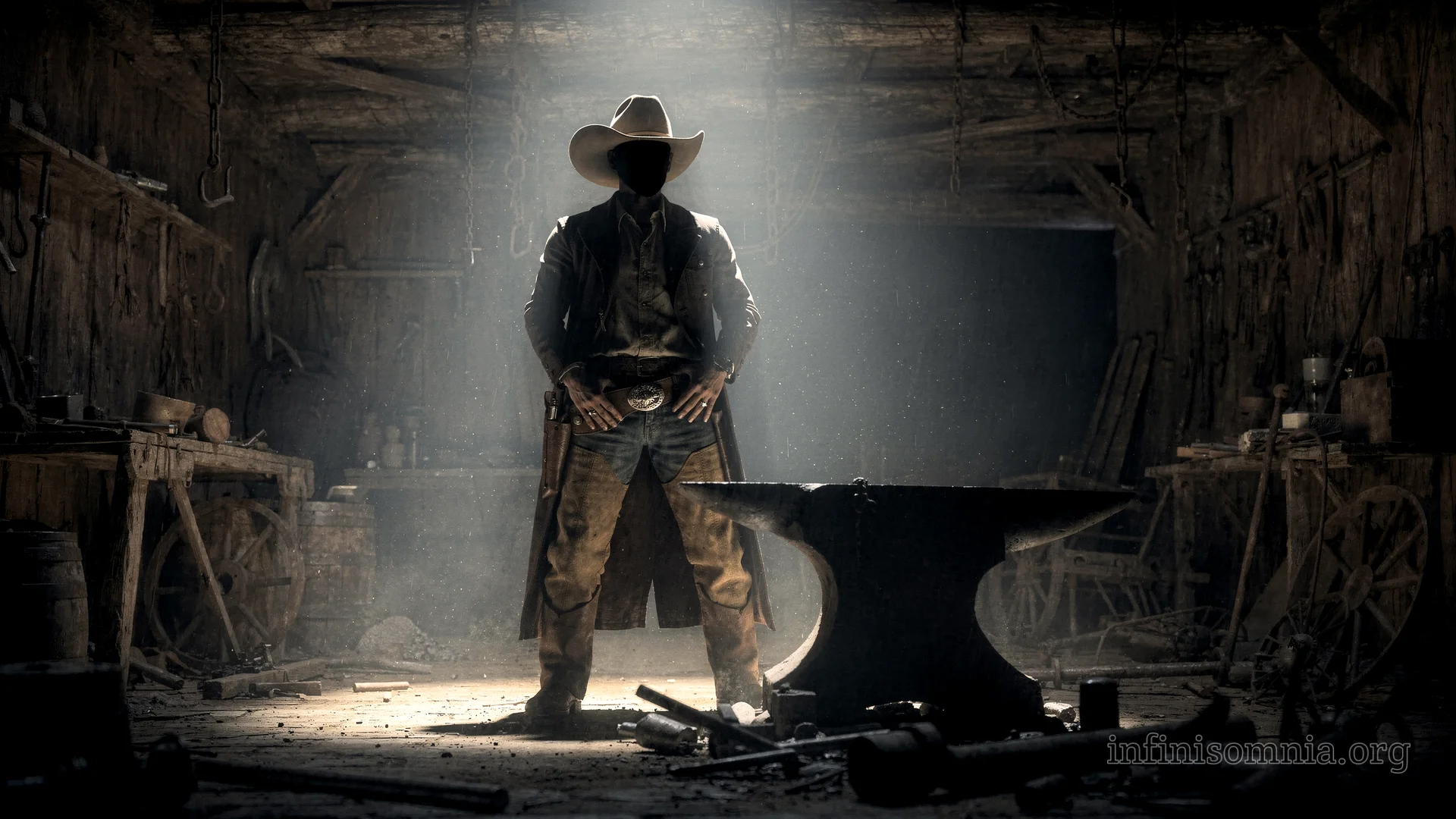
Strictly speaking, the idea for this episode wasn’t mine at all, but Miray’s. Even though my characters have to follow the plot, I usually give them a long leash in the scenes and allow them the freedom to improvise. In this case, Miray and Dian were sitting in a teahouse with time to kill. Suddenly, Miray mentioned a previous dream set in the Wild West. She didn’t want to go into any more detail. All she would reveal was this: it ended in a wild shootout.
The episode with the tea house remained unfinished. Her idea with the Wild West survived, however, and became the foundation for this story. There is also a shoot-out in the showdown, as is fitting for a Western. Albeit with a special twist that I will not reveal at this point.
The Plot
Miray uses the moment of a romantic candlelit dinner with Dian to tell him about her adventure in Kiona Bluff.
In a previous dream, even before she met Dian, she ended up in this one-horse town in the Wild West. Her task: catch a crook. He has the reputation that his shots have never missed their target. Miray only possesses one weapon: her mind. But this weapon is no less dangerous.
The Setting
This time we have two settings at once.
The frame narrative takes place in a fictional fine-dining restaurant in present-day Dubai. The fantastic view over the city and the excellent food make the evening so perfect that, in the end, Miray actually lets herself get carried away into a brief moment of weakness.
The main plot, on the other hand, takes place in the classic Wild West. The fictional name of the small town Kiona Bluff is not chosen at random. “Kiona” is an indigenous word meaning “brown hill”. “Bluff” has an intentional double meaning. On the one hand, a desert cliff is called a “bluff” in English. On the other hand, bluffing – that is, deceiving one’s opponent – is a central component of this story.
I must admit that the great era of Western films completely passed me by. Accordingly, I had to do a lot of research, for example on stagecoaches or typical women’s clothing.
Miray’s one-handed riffle shuffle and Pepper’s ghost also come from this research.
The Characters
For the main story, Miray takes on the role of the narrator this time. Dian is left with only the significantly smaller part as the narrator of the frame narrative. I’ll make it up to you, Dian. Promise.
In the Western world, I tried to give the characters more depth than usual. Especially the smart farm boy Cal was a lot of fun for me to write. Which little boy was the inspiration here should be obvious.
Just as much fun was the antagonist Bullet Ben, who is undoubtedly better at handling his shooting iron than with words. (By the way, I’ve hidden a small reference to a famous computer game from 1990 with him. Have fun searching.)
The Dream World
This episode doesn’t reveal much that’s new about the mechanics of the dream worlds. Really only that there are also dream journeys that start with a green circle, meaning they can be left immediately.
What have I learnt?
Frame narratives galore. And here I would like to be praised for my courage (or rather madness?), because this episode actually has not one or two, but a whopping four narrative levels.
- Dian’s reality: He falls asleep on a sunbathing lawn at the outdoor pool.
- The actual dream journey: The romantic dinner with Miray in the Burj al Sahar.
- Miray’s adventure in Kiona Bluff, including the switch to Miray as the first-person narrator.
- The duel between Bullet Ben and the mysterious cowboy. Here, the narrative perspective changes once again, namely to an omniscient narrator.
In general, I’ve learnt that the constellation of a heroine and a narrating companion has a serious disadvantage. Narratively speaking, it’s very difficult to let Miray do something on her own for once. Dian always has to be there, otherwise he can’t know what happened and consequently can’t tell about it. Or I use the trick of switching narrators, but if I overdo it, my esteemed readers will eventually lose track.
The first-person perspective is usually easier for those starting out with creative writing, as we also think in the first person. Initially, I even assumed that the first-person and omniscient perspectives were basically interchangeable at will, and were more or less limited to a change in personal pronouns.
I know better now. But that is also the actual goal of my journey as an amateur writer: making mistakes, learning from them, and having fun in the process.