Finally, after almost three years of development, I have published the source code of Cilla. Cilla is the software that runs this blog.
I started working on a new blog software on June 3, 2009. It should replace my old home page made with PHP. I decided to write an own blog software in Java, as there was no open source Java blog software that suited my needs. However I never expected that this project would grow that huge. The core modules alone consist of 27,000 lines of code in 295 classes.
The core modules of Cilla are now available on my development site shredzone.org. The source code is published on Codefloe. The documentation, a few plugins, and a simple example web frontend are still missing. I will publish them later.
Cilla is published under a GNU Affero General Public License.
If you’re using Maven’s hibernate3-maven-plugin for creating a DDL file from your entities, you might encounter the following error when using Java 1.7:
Execution default of goal org.codehaus.mojo:hibernate3-maven-plugin:2.2:hbm2ddl failed:
An AnnotationConfiguration instance is required
The reason seems to be a broken JRE detection in the Mojo code, which mistakenly assumes that Java 1.7 does not support annotations. However, I haven’t checked that in depth.
The fix is pretty easy. In the plugin configuration of the hibernate3-maven-plugin, add an implementation property to the componentProperties like this:
<plugin>
  <groupId>org.codehaus.mojo</groupId>
  <artifactId>hibernate3-maven-plugin</artifactId>
  <version>2.2</version>
  <configuration>
    <componentProperties>
      <implementation>annotationconfiguration</implementation>
    </componentProperties>
  </configuration>
</plugin>
This enforces the use of an AnnotationConfiguration instance.
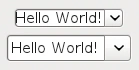
JComboBox, the usual way is to extend a DefaultListCellRenderer and override the getListCellRendererComponent() method. However, this may lead to ugly comboboxes on some Look and Feels. As you can see on the top combobox, it is rendered considerably smaller and with the letters sticked to the left border, just by using a DefaultListCellRenderer. The Look and Feel seems to use a special renderer class for proper rendering, as it is shown in the combobox below.A solution is to use a proxy ListCellRenderer instead, which only converts the value and then delegates the rendering to the original renderer. For example:
public class ListCellRendererProxy implements ListCellRenderer {
  private final ListCellRenderer delegate;

  public ListCellRendererProxy(ListCellRenderer delegate) {
    this.delegate = delegate;
  }

  @Override
  public Component getListCellRendererComponent(JList list, Object value,
                int index, boolean isSelected, boolean cellHasFocus) {
    // modify the value here...
    return delegate.getListCellRendererComponent(list, value, index, isSelected, cellHasFocus);
  }
}
The renderer proxy can be used like this:
JComboBox cbx = new JComboBox();
ListCellRenderer oldRenderer = cbx.getRenderer();
cbx.setRenderer(new ListCellRendererProxy(oldRenderer));
The combobox items are now converted to a string by a custom cell renderer, but are still rendered by the original renderer implementation of the current Look and Feel. However, while a single DefaultListCellRenderer instance can be shared with many JComboBox, a new renderer proxy needs to be instanciated per combobox.
For String properties that may contain more than 255 characters, it is advised to add a @Lob annotation to the appropriate property. For example, to keep a comment text in an entity, one would write:
@Lob
public String getComment() { return comment; }
public void setComment(String comment) { this.comment = comment; }
On PostgreSQL, a large string is usually kept in a TEXT column (instead of VARCHAR). However, after updating to Hibernate 3.6, an exception was suddenly thrown when accessing such a property (along with an SQLState: 22003 from PostgreSQL):
org.postgresql.util.PSQLException: Bad value for type long : This is some text...
	at org.postgresql.jdbc2.AbstractJdbc2ResultSet.toLong(AbstractJdbc2ResultSet.java:2796)
	at org.postgresql.jdbc2.AbstractJdbc2ResultSet.getLong(AbstractJdbc2ResultSet.java:2019)
	at org.postgresql.jdbc4.Jdbc4ResultSet.getClob(Jdbc4ResultSet.java:43)
	at org.postgresql.jdbc2.AbstractJdbc2ResultSet.getClob(AbstractJdbc2ResultSet.java:384)
        ... and more
Obviously, the PostgreSQL connector tried to interprete the textual content as a long integer now, which - of course - results in a failure. PostgreSQL knows two ways of storing binary large objects, either as BYTEA within the table space, or as OID in a separate place and referenced by a numerical identifier. It seems that Hibernate 3.6 suddenly treats TEXT columns like OID columns as well.
In the internet, I have found similar problems related to @Lob annotated byte[] properties. A common solution was to add a @Type annotation to the property.
An attempt to add @Type(type = "org.hibernate.type.MaterializedClobType") did not help at all. Instead, @Type(type = "org.hibernate.type.TextType") did the trick:
@Lob
@Type(type = "org.hibernate.type.TextType")
public String getComment() { return comment; }
public void setComment(String comment) { this.comment = comment; }
Update: An alternative proposed by valsaraj is to use @Column(columnDefinition = "text"), which requires not to use @Lob at Strings at all:
@Column(columnDefinition = "text")
public String getComment() { return comment; }
public void setComment(String comment) { this.comment = comment; }
I think this is the better solution, however it requires the underlying database to support the text column type.
For PostgreSQL, it now works fine again, even without needing to alter the table column type. However I couldn’t check the impact of the annotation on other DBMS (like Oracle). Your feedback is welcome.
I stumbled upon a strange issue when I recently deployed a JSF 2.0 web application. The application was developed using Jetty, and was working fine there. However when I deployed the application on a server, the page layout was utterly broken and Firefox complained that it would not load some CSS resources because of the wrong content type application/xml+xhtml.
On the server, a Tomcat is connected to an Apache web server via mod_proxy and mod_proxy_ajp. I found out that the Tomcat itself delivered the CSS resources without a Content-Type header, but the Apache web server returned a Content-Type: application/xml+xhtml. Actually, mod_proxy always adds a Content-Type header if it is missing, and tries to guess the right content type by the file suffix.
I searched the net for a proper solution of this issue, but found none. After some experiments, a working solution was to configure the Apache web server to force the content type of all .css.xhtml files to text/css:
<LocationMatch "\.css\.xhtml$">
    ForceType text/css
</LocationMatch>
However I don’t know if this is the best practice. A likely better solution would be the Mojarra Faces servlet to return a proper content type for the CSS files.